
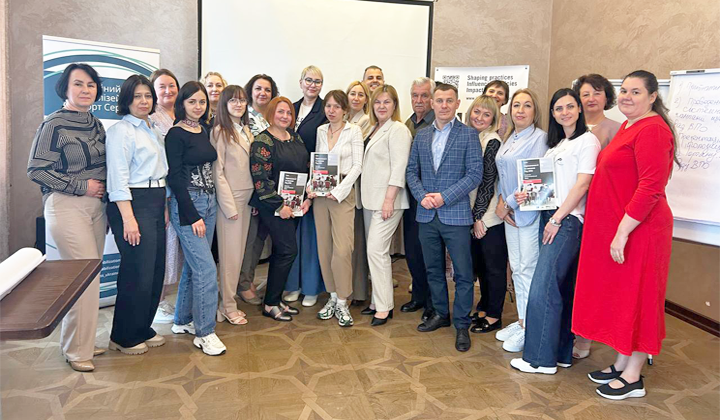
The “Capabilities and Challenges of IDP Councils” study is dedicated to the activities of Councils on Internally Displaced Persons and was conducted by REACH (IMPACT Initiatives) in partnership with the Charity Foundation “Stabilization Support Services,” with funding from European Union Civil Protection and Humanitarian Aid, from February to May 2025.
The goal of the study is to provide a factual, data-driven assessment of the state of IDP Councils across Ukraine, identify key challenges to their functioning, and develop practical recommendations for improving their work.
Findings of the Study
According to the findings, despite the limited powers of IDP Councils, lack of funding, and a large number of tasks, the Councils are gradually transforming into effective platforms for interaction between displaced people and local authorities. Their activities contribute to finding effective solutions at the community level. This helps IDPs integrate into the life of their new communities, defend their rights, and participate in policymaking.
Although IDP Councils have only advisory status and are not legal entities, with community support and the involvement of the IDPs themselves, they can influence local processes, shape initiatives, and promote change. To strengthen this role, it is important not only to provide resources to the Councils but also to gain a deeper understanding of their requests, barriers, and needs in exercising the powers provided for by the Model Regulation on the Council for Internally Displaced Persons.
Key aspects of the current activities of IDP Councils that require special attention:
- On average, only 48% of IDP Council members are IDPs themselves (below the 50% minimum defined by the Model Regulation). The lowest figure is in the western regions (41%).
- IDP Councils are predominantly composed of women (76%).
- Every fifth Council operates thanks to the efforts of one or two of its most active members.
- 22% of Councils held meetings less frequently than once a quarter.
- Council members often provide direct assistance to displaced persons, which is outside their official mandate, due to the lack of other support mechanisms in the communities.
- Most Councils lack an office, equipment, or funding. Some Council heads purchase office supplies or print documents at their own expense.
- There is no effective system for sharing experience among IDP Councils, and there is no stable connection with the central government. Fewer than half of the Councils are in contact with other Councils.
The establishment of IDP Councils is a genuine attempt to give the displaced community a voice in solving local issues. They have the potential to be effective but require a clear structure, resources, and partnership. The study’s findings provide the first comprehensive overview of the state of affairs in communities, allow us to hear the voice of the IDP Councils themselves, and determine the vector for future changes. The resulting analytics will become a foundation for strategic decision-making for both international donors and the Ukrainian government.
Methodology
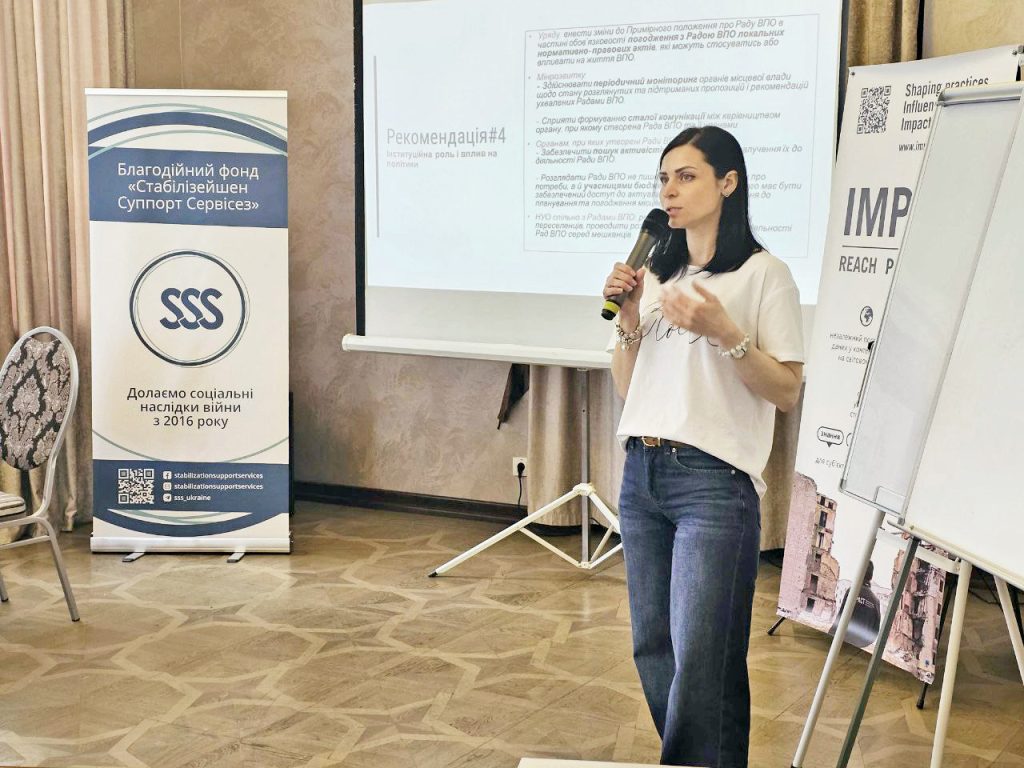
The study combines quantitative and qualitative approaches with geographical stratification. According to mapping conducted by the CF SSS in partnership with the Ministry for Reintegration of the Temporarily Occupied Territories of Ukraine in August 2024, the general population consisted of 654 IDP Councils established under local self-government bodies of city, settlement, and village communities.
The representative sample included 431 Councils (66% of the total), taking into account three macro-regions: West, North-Center, and South-East. The survey was conducted by telephone in February 2025 using a standardized questionnaire. Among the contacts who were reached, the response rate was 88%. Two focus groups and eight in-depth interviews were conducted with representatives of local authorities, civil society organizations, and IDP Councils.
This publication was made with the support of UNHCR, the UN Refugee Agency in Ukraine. The content of the publication is the sole responsibility of the Charitable Organization “Charity Foundation “Stabilization Support Services” and does not reflect the views of UNHCR.