
How can one community’s successful experience become a catalyst for change in another? By seeing successful practices firsthand, asking questions to those who have already overcome similar challenges, and understanding how proven solutions can be adapted to local needs. This opportunity was offered to participants of the first IDP Council exchange visit, held in Poltava on 2–3 July.
The event was organized by the Charity Foundation “Stabilization Support Services” with the support of UNHCR, the UN Refugee Agency in Ukraine.
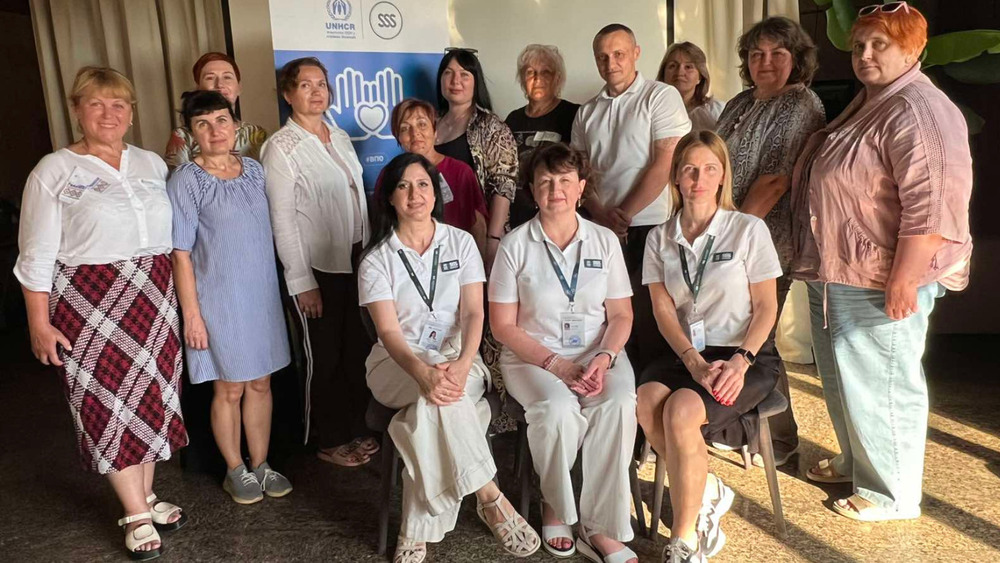
Fourteen representatives of IDP Councils from Poltavska, Dnipropetrovska, and Sumska oblasts took part in the exchange visit. Over the course of two days, they explored successful approaches to supporting internally displaced people, learned about locally implemented projects, discussed common challenges with their peers, and identified practical solutions that could be adapted in their own communities.
Among the most inspiring moments were real-life stories demonstrating how local initiatives can evolve into sustainable support systems.
Oleksandr Kandyba, Head of the IDP Council under the Synelnykove City Council, shared how a grassroots initiative supporting internally displaced people gradually developed into a comprehensive social service system, providing emergency shelter, residential care, social support, and legal assistance.
“We started with a single house for people who needed help. Today, our organization provides accommodation in seven houses, currently home to more than 140 people. Nearly half of them are older internally displaced people. We also support local residents facing difficult life circumstances. Whenever necessary, we help them restore their documents and find employment,” said Oleksandr Kandyba.
His presentation sparked lively discussions among participants.
“Representatives of the IDP Council from the Hoholeve community saw this as a potential solution for supporting people evacuated from frontline areas who require long-term care. Other IDP Councils were interested in learning how to build similar partnerships with local authorities, where to find partners, and how to combine the work of a civil society organization with the activities of an IDP Council,” explained Oksana Luhova, Regional Coordinator of Charity Foundation Stabilization Support Services in Poltava Region.
The exchange visit combined presentations of practical case studies with field visits to local initiatives. Participants visited the “MyRazom” IDP Support Centre for Kramatorsk District in Poltava, where they learned about a comprehensive model of assistance for internally displaced people. They explored how legal, medical, social, and integration services are delivered under one roof.
Participants also received insights from Olha Saienko, Head of the Department for Reintegration and Social Protection of Veterans and Internally Displaced Persons at the Poltava Regional Military Administration, who explained mechanisms for developing local housing policies and establishing new IDP support centres within communities.
Another stop on the programme was the construction site of Poltava’s first multi-apartment social housing project for the temporary accommodation of internally displaced people. The project is being implemented by the Poltava City Council with the support of UNHCR and its partner MoveUkraine. Participants had an opportunity to observe the project’s progress, learn about implementation challenges, and ask practical questions about launching similar initiatives in their own communities.
During practical workshops, participants analysed the case studies they had seen, identified which approaches could be adapted locally, and developed initial advocacy steps for bringing these ideas to life. Representatives of the Hradyzk community, for example, drafted an action plan to establish an IDP Support Centre and expand their temporary housing stock while attending the event.
“Following the exchange visit, participants continue communicating through a shared online group, where they exchange experiences, practical advice, and useful resources. According to participants, the visit became a source of new ideas, motivation, and confidence that even complex initiatives can be successfully implemented in their own communities,” said Oksana Luhova.
“These exchange visits allow us to see successful initiatives that are already working in other communities. We would like to adapt the experience of the Synelnykove community. Their supported housing model helps address accommodation needs for the most vulnerable internally displaced people. Once you see proven solutions in practice, you begin looking for ways to implement them yourself,” said Nataliia Hohol, member of the Coordinating IDP Council under the Executive Committee of the Hoholeve Settlement Council.
Such peer-learning opportunities are especially valuable for newly appointed members of IDP Councils who have recently joined these advisory bodies.
“For me, this visit was a real source of inspiration. It was incredibly valuable to hear experienced colleagues openly share their experience of working with local authorities. I recently joined the IDP Council under the Hradyzk Settlement Council, and after participating in the exchange visit to Poltava, I already have several ideas that we would like to implement. One of them is establishing a hub for a relocated community in our own municipality,” shared IDP Council member Alina Pavliukovych.
This publication was made with the support of UNHCR, the UN Refugee Agency in Ukraine. The content of the publication is the sole responsibility of the Charitable Organization “Charity Foundation “Stabilization Support Services” and does not reflect the views of UNHCR.