
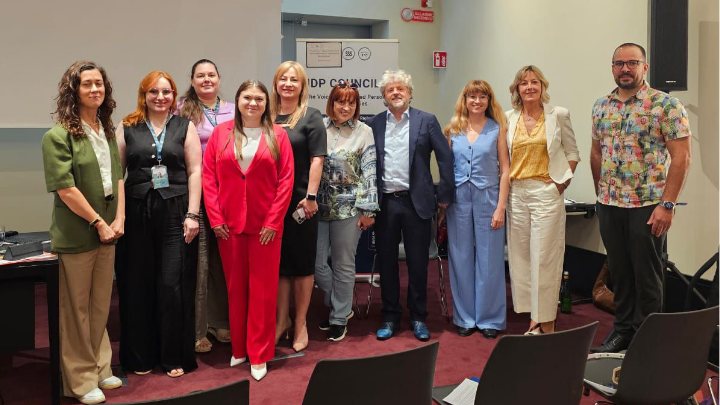
At the beginning of July in Rome, ahead of the international Ukrainian Recovery Conference, a roundtable discussion was held to present recommendations and successful practices for engaging IDP (internally displaced persons) Councils, the diaspora, and refugees in Ukraine’s recovery. Representatives of IDP Councils, together with Ukrainian and international civil society organizations, organized a dedicated event with the participation of international experts and government officials.
IDP Councils as Strategic Partners in Reconstruction and State Policy Development
Paula Gaviria Betancur, UN Special Rapporteur on the Human Rights of Internally Displaced Persons, announced the extension of her mandate for another three years and pledged to continue supporting the development of the IDP Council network and advocating for displaced persons in Ukraine and worldwide.
“Internally displaced persons are not merely aid recipients, nor simply victims. They are rights-holders, citizens, agents of recovery, agents of change, agents of peace,” — said Paula Gaviria Betancur.
During the event, a new project was announced to establish structured dialogue between Ukrainians in Europe and IDP Councils in Ukraine. Doron Verstraelen, External Affairs Coordinator of the Dutch Ministry of Asylum and Migration expressed strong interest in the project implemented by Ukraine’s Stabilization Support Services (SSS) and the Dutch organization OpenEmbassy. He emphasized that this dialogue could shape policymaking in both countries and support initiatives in education and entrepreneurship.
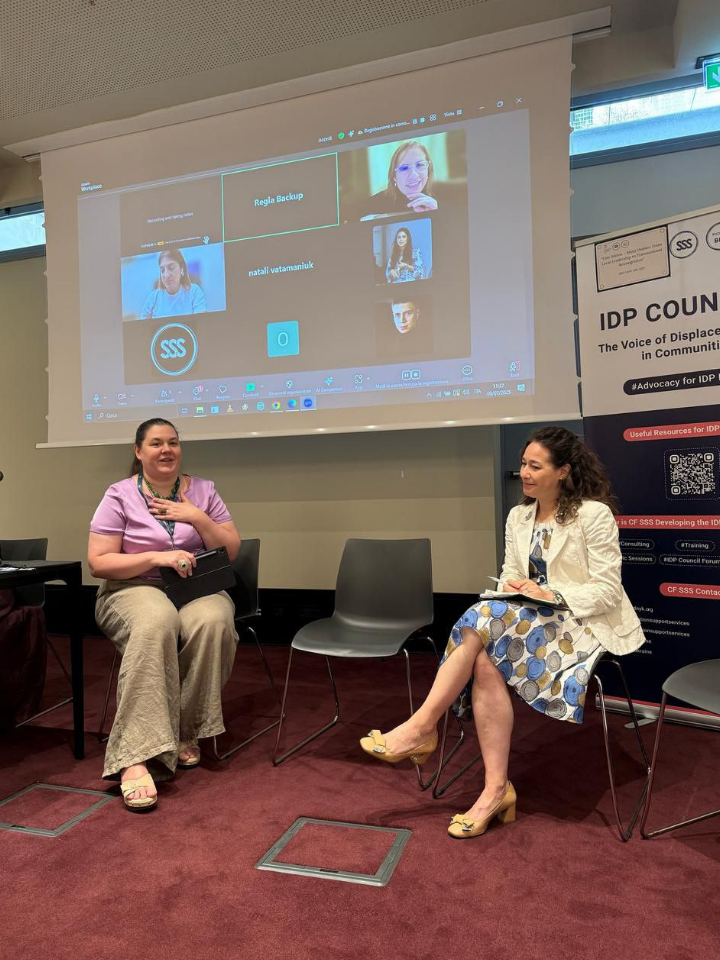
Valeriia Vershynina, Executive Director of Stabilization Support Services and Co-founder of the Congress of IDP Councils, stated:
“IDP Councils are actively involved in local recovery initiatives — from infrastructure consultations to program development for residents. However, engagement in national-level change is still lacking. Many decisions, programs, and strategies are made without considering the voices of displaced persons. We need a systemic collaboration between the government, donors, IDP Councils, and other representatives of affected populations. We call on the government to take the lead in this process.”
Currently, over 800 IDP Councils operate across 66% of all communities in Ukraine that host displaced populations.
Expanding the Role of IDP Councils
Anna Chernova of the NGO “Posmishka UA” urged stakeholders not to reduce the role of displaced people to mere service recipients. She emphasized that IDP Councils are seen as strategic partners rather than just service providers — they are fully integrated into local contexts and ready to act as full participants in community life and recovery.
Martina Ranieli, Head of Department at the International Institute of Humanitarian Law, stressed the importance of creating neutral and safe spaces for dialogue between the government and displaced persons. She noted that such environments foster mutual understanding and that ongoing work aims to enable people with displacement experience to co-create projects and programs — and to engage directly with government representatives from various countries.
Return Policy: Challenges and Solutions
The issue of return is not only linked to security but also to systemic policy challenges concerning IDPs. Yana Liubimova, Co-founder of the Congress of IDP Councils, presented the development of a consolidated advocacy position on internal displacement policy, supported by the International Renaissance Foundation. This process identified 11 key challenges, including the lack of clear coordination after responsibilities were split between the Ministry for Communities and Territories Development and the Ministry of Social Policy. Crucially, there is a need to recognize IDPs as partners in the recovery process.
Aliona Luniova from the Human Rights Center ZMINA also spoke about the lack of coordination at the ministerial level following the closure of the Ministry of Reintegration at the end of 2024. She mentioned a joint statement by human rights organizations highlighting the need to include issues related to temporarily occupied territories in the agenda of the Ukrainian Recovery Conference — topics that are often overlooked in discussions about human capital.
Participants agreed to develop a policy document with recommendations for governments, build a partnership network between IDP Councils and Ukrainian organizations abroad, and launch cross-border platforms for dialogue and return support.
About the Ukrainian Recovery Conference
The roundtable took place on the eve of the main Ukrainian Recovery Conference in Rome, where international donors gathered to discuss multibillion-dollar investment needs for Ukraine’s reconstruction. Ukrainian delegates emphasized the importance of the human dimension in these processes alongside economic concerns.
According to organizers, this was the first international-level attempt to discuss concrete mechanisms for engaging the Ukrainian diaspora not as aid recipients but as active partners in rebuilding the country.
The event was organized by the Stabilization Support Services Charitable Foundation with the support of the International Renaissance Foundation and McGill University (Canada).
This publication was made with the support of UNHCR, the UN Refugee Agency in Ukraine. The content of the publication is the sole responsibility of the Charitable Organization “Charity Foundation “Stabilization Support Services” and does not reflect the views of UNHCR.